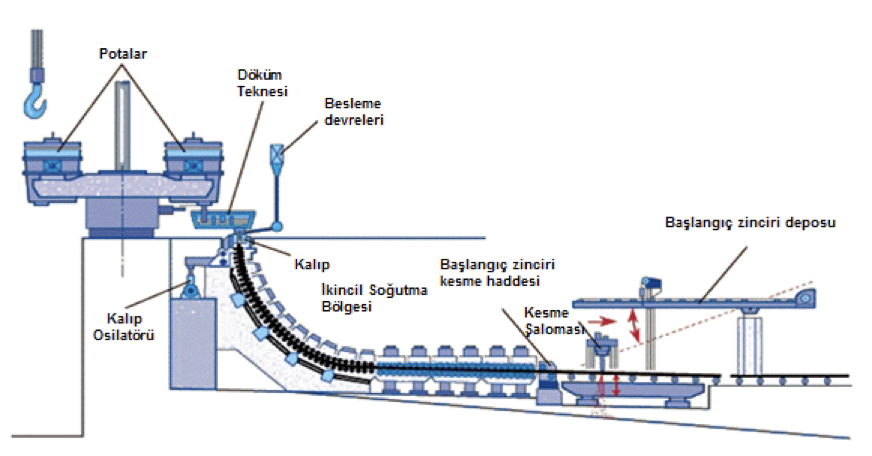
Continuous Casting Machine (SDM)
Liquid steel is solidified in a continuous casting machine to become an intermediate product. The liquid steel flowing from the bottom of the ladle into the tundish is distributed into paths, where it solidifies in copper molds (of various cross-sections) along each path. For complete solidification, water is sprayed onto the steel surfaces in a chamber beneath the copper molds. Then, it is brought horizontally by means of pullers and straighteners, cut into various lengths by flame cutting or shearing, and cooled on a cooling platform. Flat billets are cast for flat products, and large billets or beam blanks are cast for long products.
In steel plants, casting machines are used to solidify molten steel into uniform shapes (bills, blooms, beam blanks, slabs) according to the final product to be manufactured. Billets, blooms, and beam blanks are used in the production of long products such as bars, coils, profiles, and rails; slabs are used in the production of flat products; and ingots are used in the manufacture of special machine elements such as shafts, rollers, gears, and propeller blades.
Continuous casting machines (CDMs) are commonly used in steel mills engaged in mass production. These machines have varying radii and numbers of paths depending on parameters such as product cross-section, product quality, and casting speed. There are different applications, such as open and closed casting.
The continuous casting machine includes the following equipment:
- Pot Turret / Pot Cart
- Tandishes and Tandish carts
- Molds
- Mold oscillation systems
- Mold level control systems
- Tractors and straighteners
- Driver relay
- Mechanical or flame cutting systems
- Rigid Dummy Bar
- Relay roads
- Cross-country transfer
- Cooling platform (push or rotary type)
- Secondary (mold) and primary (spray) cooling systems.
- Hydraulic, pneumatic and lubrication systems
- Electricity and automation